
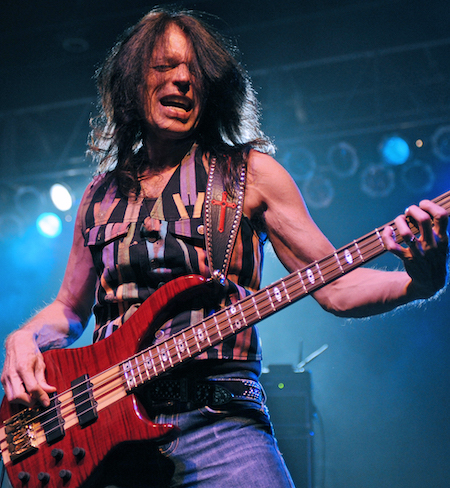
In a new interview with Thomas S. Orwat, Jr. of the Rock Interview Series, legendary rock bassist Rudy Sarzo discussed his recent admission that he utilized artificial intelligence (A.I.) during the production process of his two new solo singles, Your Heart Is The Road (listen here) and For The Love Of Love (can be heard below).
Sarzo said in part (as transcribed by blabbermouth.net), “By next year, there’s not gonna be any need [for anybody] to confess [to using A.I. in the music production process]. It’s gonna be taken as a given that some sort of an assisted A.I. has been involved with everything. Because I gotta tell you, even if you record analog and you’re doing everything with humans in the room, by the time it gets mixed, it’s gonna be A.I. assisted. All the new plugins contain that. So unless you’re using a really old-school engineer that just sticks with analog and is not gonna use any plugins, which are getting harder to find, it’s gonna be A.I. assisted. And so will be the mastering. So by a year from now, it’s not even gonna be a topic of conversation anymore. It’s like talking about MIDI. Does anybody talk about MIDI anymore? No. But back in the day, it was, like, ‘Whoa.’ Does anybody talk about loops?”
He continued, “My background, as far as technology goes, if I see it coming, I do something about it. I embrace it, because you can’t stop progress or technology in general. When loops started happening around 1995, I immediately embraced the idea. As a matter of fact, I shifted from using Logic Pro, which I had the first version of it, and I already had [Digidesign] Session 8, which was the Pro Tools interface… Just going through conventions, the NAMM Show, I came across the people who were involved with Acid, which was the first loop-based software, and it was just Windows-centric, so I cannot use my Mac. So I switched over from my Quadra 650 to an HP PC. And so I was asked by them to create the first bass loop collection… They did not ask me to include samples, but I said, ‘You know what? Let me take it a step further. Let me do some sampling here.’ So I sampled every note of four-, five-, and six-string basses that I have, and they’re included. It’s called Workingman’s Bass, and that’s — what? — 31 years ago….So 35 years later, I have that out, and I’m still working. Nobody has stolen my sound because I’m always changing. I’m always progressing. It’s not like I have one sound. I have many sounds because, to me, it’s all about music. It’s all about what fits.”
Asked what part of his new solo singles were created using A.I., Sarzo said, “Yeah, the vocalist is A.I., the instrumentation is A.I., but I have a demo. See, it’s not just about doing that. First you have to have a demo, is what I do. I mean, some people just use A.I. — let’s say Suno, which is what I use — some people use Suno, like, ‘Yeah, my girlfriend is having a birthday, so I wanna write her a song.’ So on the prompt, which is basically you’re given the opportunity to be a producer, which you get in a room with a musician that you call up because you say, Okay, this is the song.’ First the producer gets the song. ‘I’m gonna produce this.’ Or maybe the producer has written the song already, or is producing for an artist, so he’s producing an artist, or the artist brings the songs. And the producer starts thinking… This is traditional, what I’m talking about. This is how it’s been done from the beginning. So thinking about who would be good on the drums for this song, and who would be the bass player and the keyboard player. Sometimes for the whole record you have a whole session band. Sometimes you don’t. Sometimes you have different people. Steely Dan was notorious for having multiple musicians record the same song, and they would just pick… I mean, if you wanna know about that, there’s plenty of YouTube videos about that. Also, Steely Dan, with Gaucho, the record Gaucho, they actually used the first actual drum machine, and I believe this was in the ’70s, pre-LinnDrum. Their engineer offered to build it because they thought about it. They thought about, ‘Well, how about instead of bringing all these drummers in, we just create drums ourselves in the studio?’ And I believe it cost about $100,000 to build, but that’s how they did it.”
One Response
Wow, based on Sarzo’s comments about AI, I fear for the future of music and musicians.