
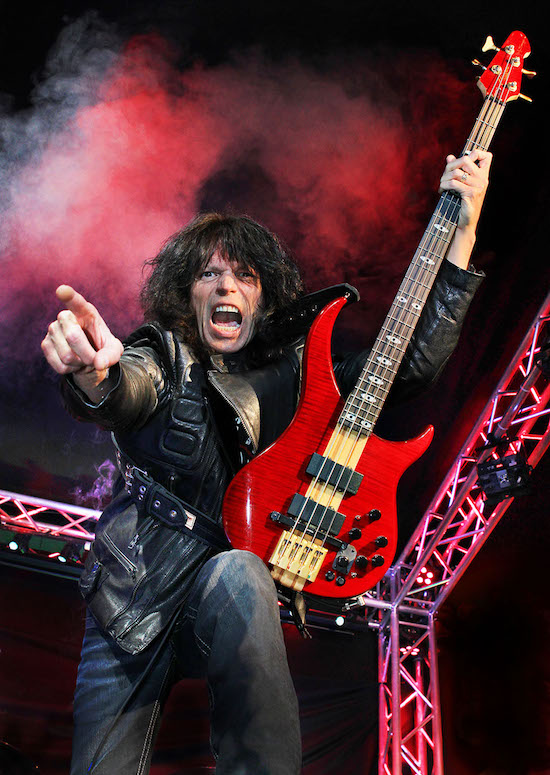
In a new interview with Ernest Skinner of Border City Rock Talk, bassist Rudy Sarzo (Quiet Riot, Ozzy Osbourne, Whitesnake) has admitted to using AI for his latest solo track, Your Heart Is The Road. The song was written in honor of his 42nd wedding anniversary to his wife, Rebecca, and can be heard below.
Sarzo stated, as per blabbermouth.net, “I come clean [about that]. There’s even bands on the road that perform live with tracks, and they don’t tell people that, ‘Hey, we got tracks. Okay, everybody, we got tracks.’ And they don’t do that. But I come clean. I say, ‘Yeah, I use artificial intelligence.’
I don’t have a budget. Who has a budget? I don’t have a budget to go home, [spend] 10 grand and dump it in the studio just for songs that [will be released independently to all the streaming services].”
Regarding why he chose to release Your Heart Is The Road on his own without the backing of a traditional record company, Sarzo explained, “I don’t wanna be on a label because I want to… I mean, I have already written about 10 [songs] that are ready to be released in intervals. But I don’t wanna be pegged into, like, put into one box. So, what you hear, the first one that you hear, don’t expect the next song to be just like it, ’cause it’s not.
“I’m doing this for a few reasons,” he added. “One of them is that I wanted to play music that I have not been playing for the last almost 50 years. It’s gonna be 50 years since I first played Slick Black Cadillac with Quiet Riot. I joined the band in 1978, and that was on the setlist. 50 years. Give me a break. I need a little bit more of a creativity in my life. And also I don’t wanna be bound to a specific box.
Back in the ’60s, bands like The Beatles or The [Rolling] Stones, they could do anything, any style of music. They could do Angie, Sympathy For The Devil or 2000 Light Years [From Home] or whatever it is. Everybody was trying new things, being creative. And the creativity, really, to me, went downhill in the ’80s, because, basically, if you had a successful record, which is the only way that you would make a second record, if you were successful, because it got to the point that selling… In the ’70s, it used to be standard, if you sold 50,000 copies of your record, you were given an opportunity to go out again and make a second record. Once MTV came in and everybody started selling multimillion on their debut albums, labels got spoiled and said, ‘Well, once you stop selling this many records, we’re gonna drop you because we have other bands in the pipeline that are ready to sell multimillion.’ So it was basically about repeating the same record over and over again until the industry itself said, ‘Well, we need something new.’ Oh, really? Yes, of course you need something new, but you’ve been telling us all along to please deliver the same record over and over again.”
He continued, “So I don’t wanna be bound to any label telling me, ‘You have to appeal to this demographic. You gotta sell this many units.’ No, I just wanna play with the diversity that I grew up playing. On any given night at a club, I would play disco, I would play a little bit of Led Zeppelin or a little bit of The Who, whatever happened to be on the radio, I played Top 40 music, which is what I grew up playing, or whatever was in Top 40, which was incredibly diverse in the late ’60s and, and early ’70s. It was all these different styles, and I loved it. I enjoyed it. Now it’s labeled yacht rock, which happens to be basically the best ’70s records… But it’s some of the best-produced and written records, engineered. I mean, you put one of those records on, you hear crystal clear every single instrument and the vocals, and I love that. Then once we got into the ’80s, the biggest culprit we had was the [Yamaha] SPX90 [legendary digital multi-effects processor released in 1985], which was the sound of the hair band. Because let’s say you had a debut album, but the record company wanted you to sound like you were already a headliner in an arena. So they put a lot of reverb in there.”
On the topic of the lyrical inspiration for Your Heart Is The Road, Sarzo said, “I wanted to write it [for my wife] because I’ve known her since 1981. So the biggest period that she and I spent away from each other was the actual ’80s. So I write the lyrics and then I start thinking of a soundtrack for the lyrics… And if you listen to the last verse, it’s about commitment beyond the grave, in a nutshell. I played in bands where musicians have not come home from the road, but you always like to feel that there’s a sense that they’re still with us, and that’s what the last verse is about.”
5 Responses
It’s not bad, has a serious Whitesnake meets Journey vibe. Also, if that is Sarzo singing, he has a good voice.
He admitted the singer is AI, so…not him-LOL!
Is it just me or is the headline click bait-y? I didn’t necessarily take away that he actually used AI on the song. Further, it’s not clear what component is AI or what AI was involved in.
He isn’t quoted specifically stating “Yes it is AI,” however, he isn’t denying it, either.
Sarzo stated that he cannot afford to record music in a studio, where he would have to pay not only for the studio time, but the fees of the musicians, as well as the engineers, etc. so it is implied he used technology.
He further explained why he did not want facilitate the use of a record company to pay for those expenses.
I’ve never considered Rudy Sarzo a songwriter, but rather a performer. I’d be interested to learn how, exactly, AI was used to write/create this song.